Soon you’ll just ask the website
Websites are learning to take instructions in plain English. What that looks like on a Tuesday morning, what it changes, and what is real today.
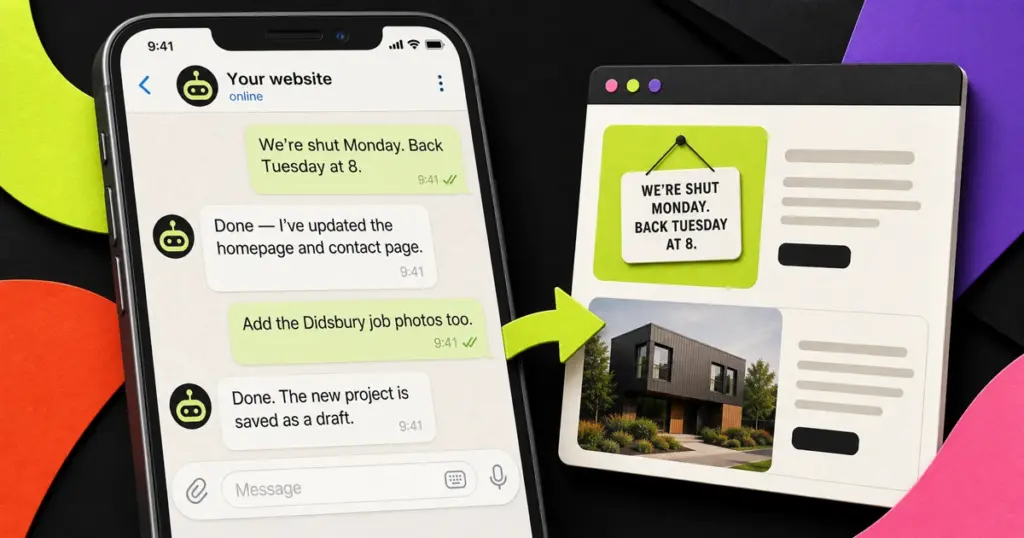
You want to put your opening hours right. Today that means one of two things. You log into something you use four times a year, click through screens you half remember, and hope the bit you edited was the bit you meant. Or you send us an email and wait until we pick it up.
Neither of those is about your business. They are both about the software. That is the bit that is about to move — and it is worth understanding now, because it changes what you should expect from a website you are paying for.
Websites are learning to take instructions
The short version: you will tell your website what you want, in your own words, and it will do it. Not by learning a system. By saying the thing you would have said to us in an email.
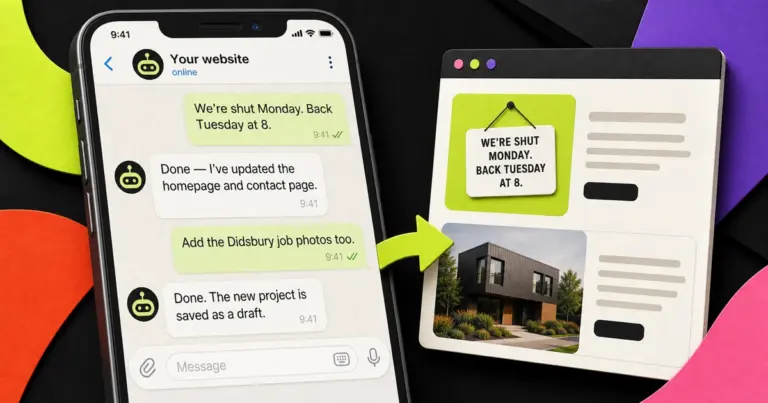
Picture a Monday morning. You are standing in a doorway with your coat on and you remember you are shut for the bank holiday. You send a message: “We’re closed Monday the 25th, back Tuesday at 8.” A minute later you get a reply telling you it has gone on the contact page and added a line to the top of the homepage — with a link so you can look at it before anyone else can.
That is the whole thing. No login. No dashboard. No trying to remember which tab the opening hours live under.
Talking counts, and so do photos
This is the part people underestimate, so it is worth saying plainly.
Most business owners will never sit down and write a blog post. The same people will happily talk for twenty seconds in the van about the job they have just finished. That twenty seconds is the blog post. Send a voice note and four photos from your phone, and get back a written page about the work, ready to read and ready to publish.
The work you are proudest of usually exists as pictures on your phone and a story you tell well out loud. This turns that into something on your website, which is where it has always belonged and rarely ends up.
It moves the words. The design holds still.
This is the question everyone asks second, so here is the answer plainly. When we build the site, we agree a list of what you can change. Everything else is settled at design stage and stays exactly as we set it.
Yours to change, any time:
- Headlines, descriptions, and the words on any page
- Opening hours, prices, phone numbers and addresses
- Blog posts and news — written, edited and published
- Photos: adding, swapping and captioning them
- Your services list, and how each one is described
- Notices at the top of the site, switched on and off
Settled at design stage:
- The layout of every page
- Typefaces, sizes and spacing
- Your colours and your logo
- How the site behaves on a phone
- Navigation and page structure
- Anything that affects how the site is found in search
Those two groups live in different places behind the scenes, which is why one can move freely while the other holds still. When you do want the design itself to change, that stays a conversation with us — the same as it is now.
How a change actually happens
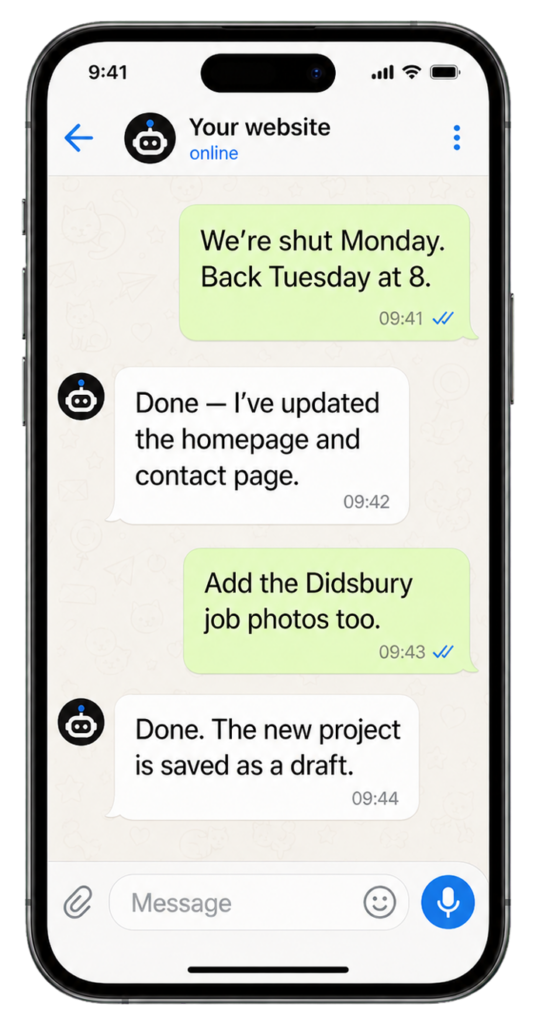
- You say what you want. Typed, spoken, or a photo with a sentence attached. However it comes out of your head is fine — there is no correct wording and nothing to learn.
- It makes the change and shows you. You get a link to the page as it would look, in your actual design, on your phone, while it is still private.
- You say yes. It goes live when you say so. Change your mind an hour later and you can say “put that back” — every version is kept.
That middle step is the important one, and it is why this ends up feeling comfortable rather than nerve-wracking. You always see it before the world does.
Two ways in
Use the AI you already have. Plenty of people now have an AI account, including free ones. We connect yours to your site, and you talk to your website inside the app you are already in. There is nothing extra to pay. This suits you if you work at a desk and are comfortable with that sort of thing.
Or message your site like a contact. We set your website up as a chat on your phone. You message it, it answers. There is no account to create and nothing new to learn — it sits in your phone next to everyone else you message. This suits you if you live on your phone and want this to be one less thing to think about.
Both do the same job. It is really a question of where you would rather be standing when you do it.
What is real today, and what is still settling
We would rather tell you where the line is than sell you a future.
Already working: the groundwork that lets a website take instructions safely became a standard part of WordPress at the end of last year, and it is in the current version. Voice notes, photos and instant replies in a chat are ordinary technology that your phone already does. In April, one of the biggest names in websites launched this as a phone chat for the sites they host — which tells you where the industry is pointed.
Still settling: the polish. How it handles an awkward request, what it does when it is unsure, and how it sounds when it writes as you. That is the part worth being patient about, and it is where we are spending our time.
We are building sites this way now so that when the last pieces land, yours is ready rather than needing rebuilding. That is the whole reason we are writing this before it is finished.
FAQs
Do I need to buy anything?
For the phone-chat version, no — you message a contact and that is it. For the version that uses your own AI account, a free account is enough to get started.
What if it writes something that does not sound like me?
You read it first and it only goes live when you say so. If the tone is off, say so in the same message thread and it will rewrite it. Over time it learns how you talk about your own work.
Can I still email you instead?
Yes. This sits alongside how we already work rather than replacing it. Plenty of changes are still quicker as a conversation with a person, and design changes always will be.
Is my site too small for this?
Small sites benefit most. The fewer people you have to spare, the more it matters that a five-minute job takes five minutes.
Next steps
Tell us the change you make most often — the one you always mean to update and never get round to. It is the fastest way for us to show you what this looks like on your site specifically, rather than in the abstract.
- Custom website design & build — how we build sites that are ready for this
- AI systems & workflow automation — the same thinking applied to the rest of your business
- Get an audit — a look at what your current site would need
- Enquire — tell us the change you make most often